


Digital business transformation means changing how your business works, using digital technologies, so you get better commercial results. The important word is changing. Buying software is not transformation. Rebuilding the way a job moves through your business, then choosing the tools that support it, is.
Here is the short answer most owners want: you probably do not need a transformation program. You need one or two of your most painful business processes redesigned around a measurable outcome. Done properly, that delivers most of what large programs chase, without the budget or the disruption.
This guide covers how to choose that process, the expensive mistakes to avoid, what has changed in Australian privacy and cyber security expectations, and when it is worth paying for help.
What digital business transformation actually means
Digital business transformation is organisational change that uses digital technologies to materially improve business performance. Three things move together for it to count:
- The process. How work flows from enquiry to payment.
- The people. Who does the work, who owns the outcome, and how they are trained.
- The platform. The digital tools, data and security controls underneath.
Move only the third and you have bought software. That is the most common and most expensive misunderstanding in this field.
The scale can be modest. A six-person accounting practice that redesigns client onboarding, so documents arrive once, complete and usable, has transformed a core business process. Real result, achievable in a quarter.
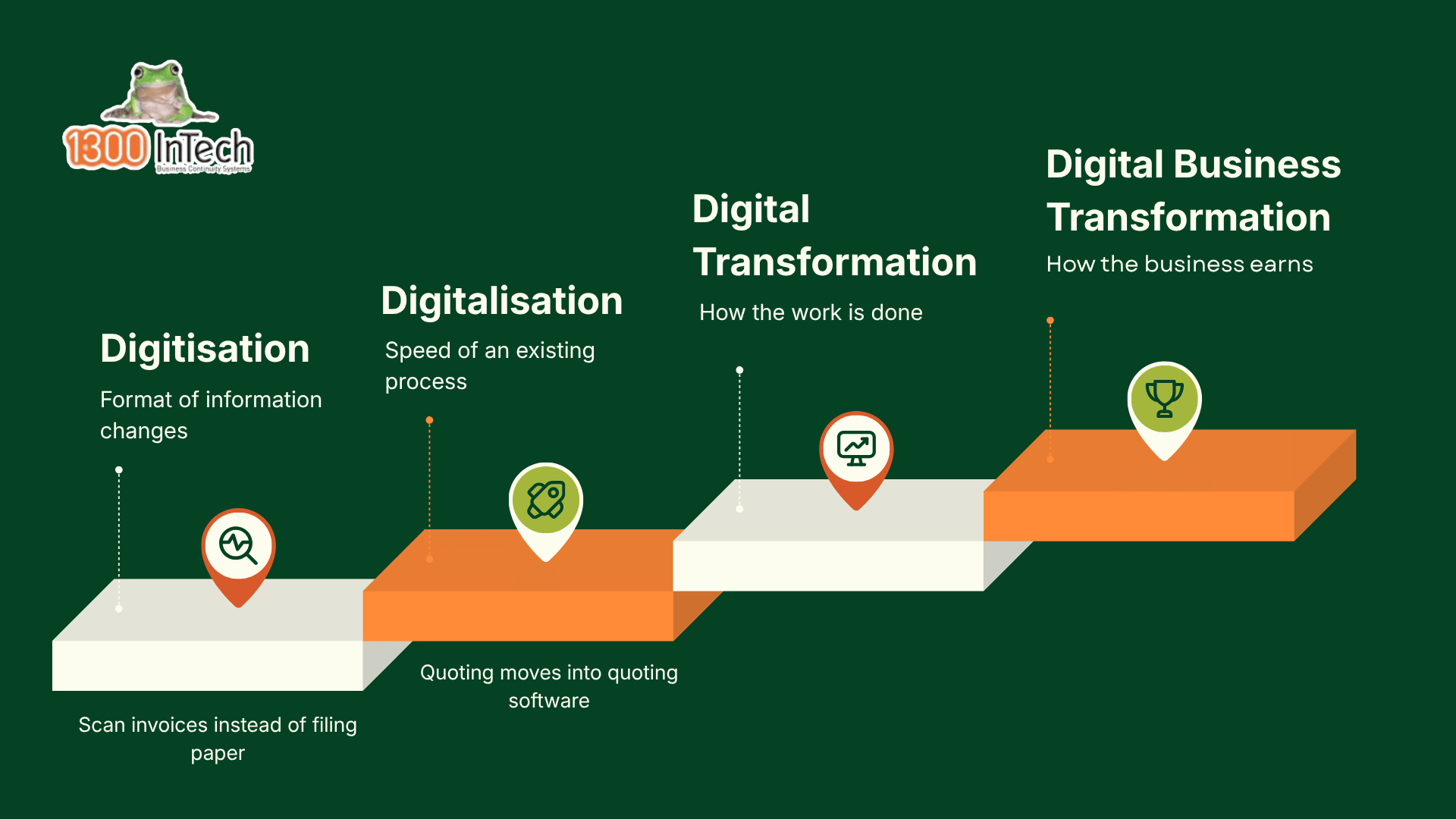
Digitisation, digitalisation and transformation: the difference that saves money
|
Term |
What changes |
Small business example |
|
Digitisation |
The format of information |
Scanning supplier invoices instead of filing paper |
|
Digitalisation |
The speed and accuracy of an existing process |
Moving quoting from Word into quoting software, same steps |
|
Digital transformation |
How the work itself is done |
Rebuilding enquiry to quote so quotes leave the same day, with no manager bottleneck |
|
Digital business transformation |
How the business earns |
Shifting from one-off jobs to monthly service plans sold through a customer portal |
Most small business projects sit in the second row, and that is often the right call. Trouble starts when a project is sold as the fourth row, budgeted as the fourth row, and delivers the second. Only the bottom row changes business models, which is why it costs more and takes longer. Knowing which row you are buying changes what you should pay and expect.
Is digital business transformation relevant to small businesses?
Yes, though usually in a narrower form than the term implies.
The Australian Bureau of Statistics found around 12% of Australian businesses used artificial intelligence during 2024 to 2025, up from about 1% two years earlier. Adoption tracked with size: roughly 35% of large businesses, 22% of medium, and about 11% of small and micro businesses (ABS, Characteristics of Australian Business, 2024-25).
The more useful finding sits underneath. Among small businesses that were innovation active, meaning they introduced or improved a product, service or process that year, adoption reached 19%. Among those doing no innovation at all, about 4%.
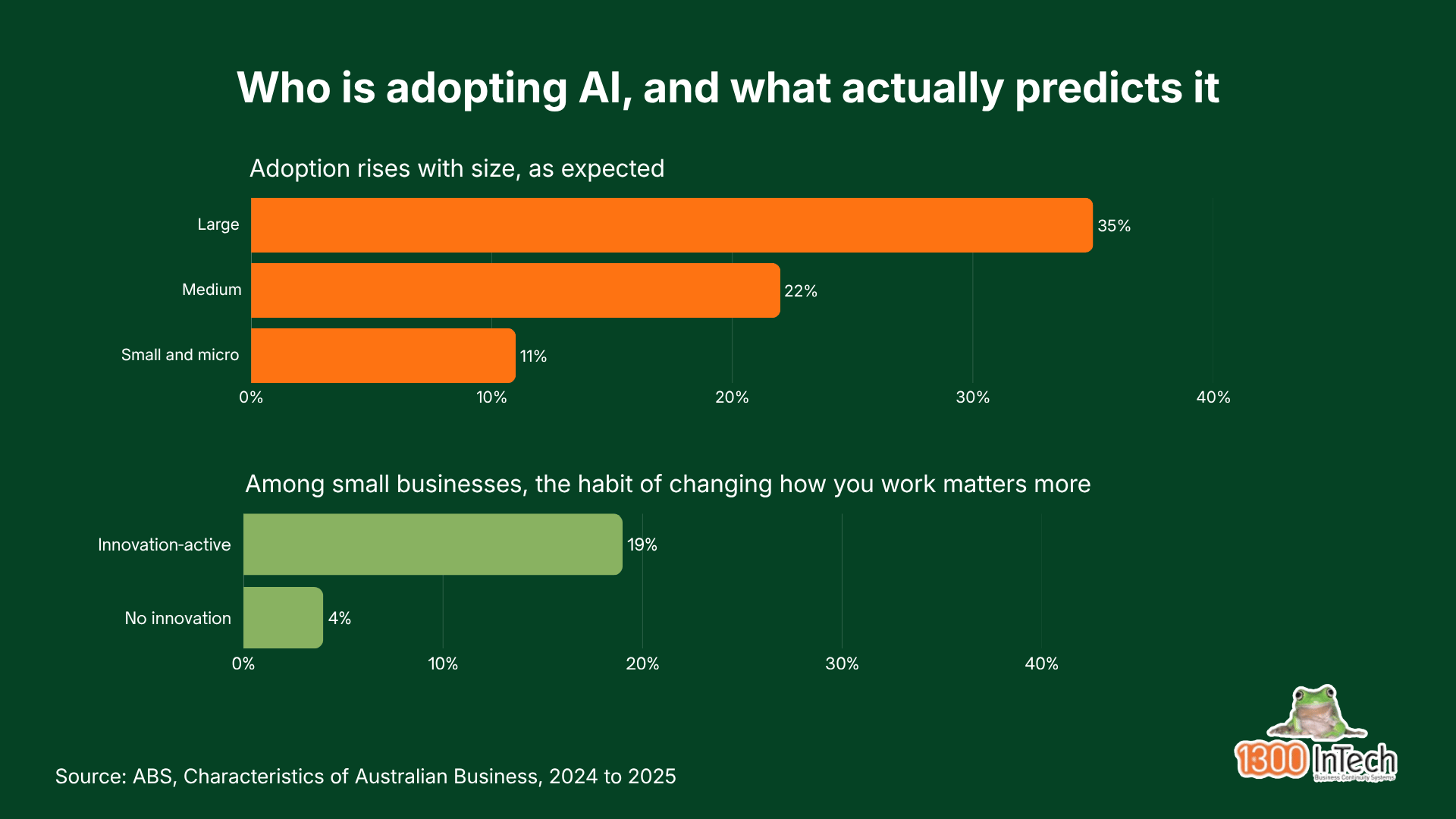
Businesses adopting digital technologies successfully already had the habit of changing how they work. Capability comes first and tools follow, which is good news on a small budget, because the habit costs nothing. Competing in the digital age has less to do with technology spend than with how fast you answer a customer.
The Four Ps: Process, People, Platform and Proof
The Four Ps are a sequence for deciding what to change and in what order: Process, People, Platform, then Proof. Projects that disappoint almost always skip the first step or the last.
Process: what should change, and should it change at all
Find the work that costs the most and produces the least. Over two weeks, watch for four signals:
• Information typed in more than once
• Jobs waiting on one person to approve, check or sign
• Customers waiting for a response you could have sent earlier
• Errors that trigger rework, credits or apology calls
Then ask the question that saves the most money: is the delay caused by the process or by the tools? If quotes take four days because a manager approves every one and is on site three days a week, no quoting software fixes it. You will pay for a subscription and still wait four days.
Redesign first, digitise second. The trade-off is real, since redesigning disrupts something that works badly but predictably. Pick a process where the pain is clear, and the change can be reversed.
People: who runs it, and will they use it
Name one person who owns the outcome, not a committee. Usually, it is whoever runs the process daily, given authority to change it. Involve them before any tool is chosen.
Staff resistance is usually rational. They can see the new way adds steps to their day even if it removes steps from someone else's. If you cannot explain how the change makes their job easier, expect low adoption. Budget real training time, because a half hour demo is not training.
How to know it is working: track how many jobs go through the new process rather than the old workaround. If people still use the spreadsheet after six weeks, that is a design problem, not a training problem.
I've found that projects rarely fail because the platform isn't good enough. They fail because the people expected to use it weren't sufficiently engaged. I've watched businesses buy the biggest, best-known systems on the market and get almost nothing from them, because the staff who'd live with it every day had no say in choosing it. The rollouts that stick are the ones where you build a good team around the right leader and involve them as early as possible, so they own the decision rather than have it handed down.
Platform: the tools, data and controls underneath
Choose tools last, once you know what the process requires. Five things to check.
Legacy systems. Older systems rarely need replacing all at once, and attempting it is how modernisation projects get expensive. Prioritise the applications that cost the most to maintain, or that block the process you are fixing. Incremental replacement reduces both disruption and technical debt and lets you stop if the first stage does not deliver. Our guide to the most common cloud migration mistakes covers the ones that cost the most to unwind.
Cloud, chosen selectively. Cloud platforms give you flexibility, scalability and support for staff working across sites, and they shift maintenance off your plate. ‘Selectively’ is the key word here. Move the services where benefits are real rather than migrating everything because it is the default answer. Some workloads are cheaper and simpler where they are. If you are weighing options, we cover the current cloud computing trends in more detail separately.
Integration. Disconnected digital tools are the standard small business problem: a booking system, an accounting package, a spreadsheet and an inbox that never speak to each other. Ask whether a new tool connects to what you already run, and how. "It has an API" is not an answer unless someone is paid to use it.
Data quality. Automation applied to bad data produces fast, confident errors. If your customer list holds three versions of the same client, fix that first.
Security, built in rather than added later. Modernisation does not improve security on its own. New systems add accounts, integrations, and data stores, which widen the attack surface. Security improves when controls are designed from the start, and retrofitting them afterwards costs more. The Australian Signals Directorate received over 84,700 cybercrime reports in 2024 to 2025, and the average self-reported cost per report for a small business rose 14% to $56,600, with email compromise the most reported category (ASD, Annual Cyber Threat Report 2024-25). Multi factor authentication on your key accounts is still the highest value first step. For a practical starting checklist, our Cybersecurity Playbook sets out twelve steps written for small businesses without an IT team, and is free to download. The ACSC's Small Business Cyber Security Guide is another free option if you would rather start with the government guidance.
A very important question before you sign anything: ask how you get your data out, in what format, and what happens if you cancel.
And, take particular care with Legacy migrations, which can be a nightmare: old code with little documentation, so nobody still in the building fully understands the way the system works. That accumulated logic can break at cutover, because it only surfaces when you try to replicate it.
That's why so much COBOL from the 1970s still runs in Australian government and big business. When Services Australia set out to replace Centrelink's 1980s payments mainframe, the overhaul ran seven years and cost more than $1.58 billion, and the core calculator still was not finished at the end (iTnews, WPIT overhaul ends after 7 years). I know a COBOL contractor who retired a few years ago who told me he was one of the last still working in Canberra, which is the real risk with these systems: eventually the only people who understand them are gone. In the old days we managed that risk by running new systems in parallel with the old, comparing the output line by line before switching. It's time-consuming and expensive, but still the surest way to catch what breaks before it falls over in production.
Proof: what you will measure
Write down the current number before you change anything. If you cannot state today's figures, you cannot prove the project worked. Useful baselines:
• Hours per week spent on the task
• Days from enquiry to quote, or quote to invoice
• Percentage of jobs completed without rework
• Enquiries that never receive a response
• Days from invoice issued to payment received
Pick one primary measure, two at most.
A worked example: same budget, different order
Illustrative only. This is not a real customer case study.
A Melbourne commercial plumbing business with 12 staff is losing work. Enquiries arrive by phone, email and a website form, and nobody is sure how many go unanswered.
Version A: buy a tool. The owner subscribes to a CRM, imports contacts, and asks the team to log enquiries. Three months on, the coordinator logs most of them, the field team logs almost none, and quotes still take four days.
Version B: measure, redesign, then buy. Two weeks of counting shows 41 enquiries, six with no response, and an average of 4.2 days to quote. Most of that delay is a pricing check the owner does on every job, including routine ones.
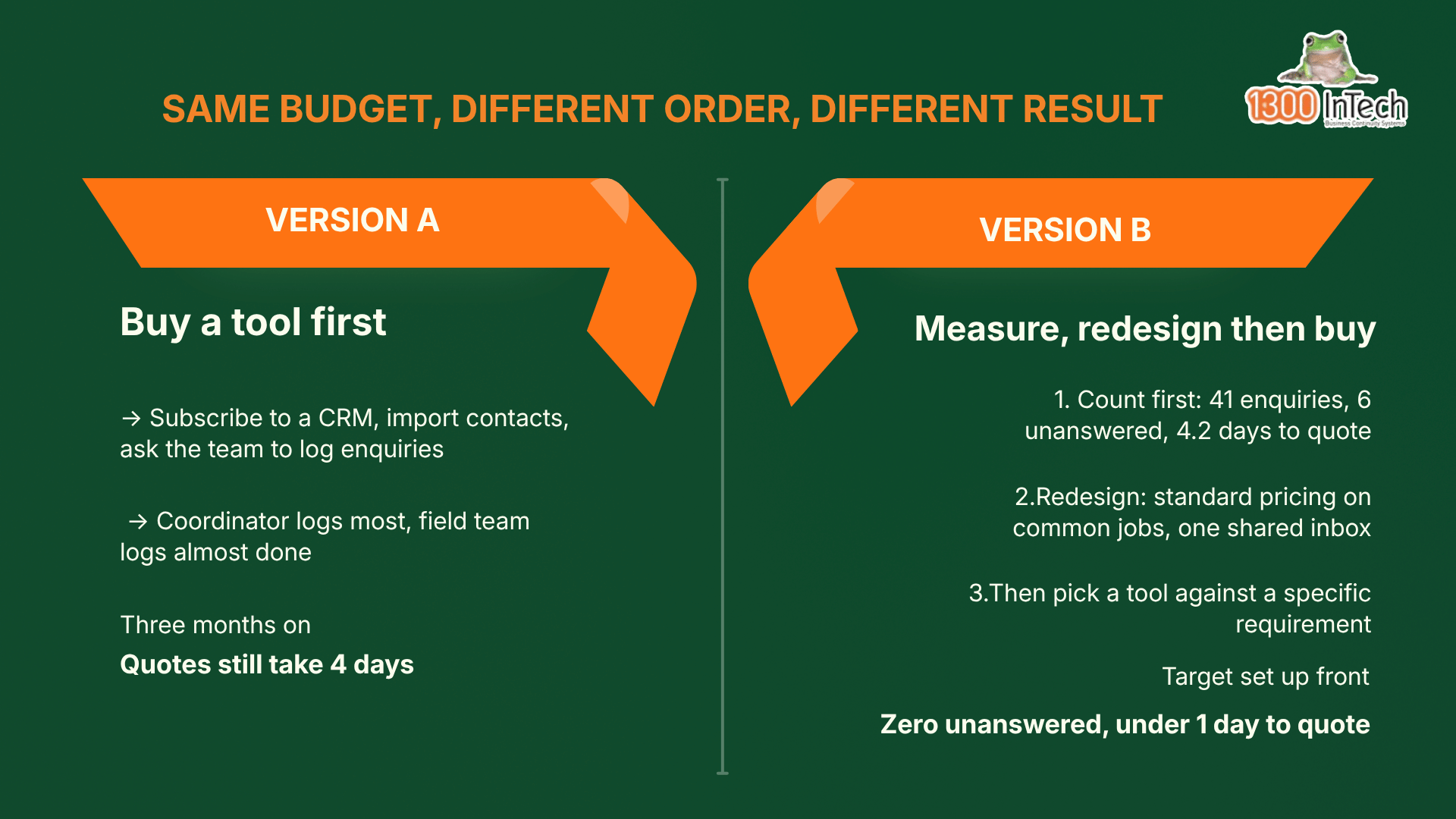
The redesign comes first: standard pricing for the eight most common job types, so those quotes need no approval, with only higher value jobs coming to the owner. A shared inbox gives every enquiry one landing place and a named owner each day.
Only then is a tool selected, against a specific requirement: capture enquiries from three channels, flag anything unanswered after four hours, produce a quote from a template. The target is set up front, being zero unanswered enquiries and time to quote under one day.
Same budget, different order. Version B fixes the cause rather than the symptom.
How to run a digital transformation project in 90 days
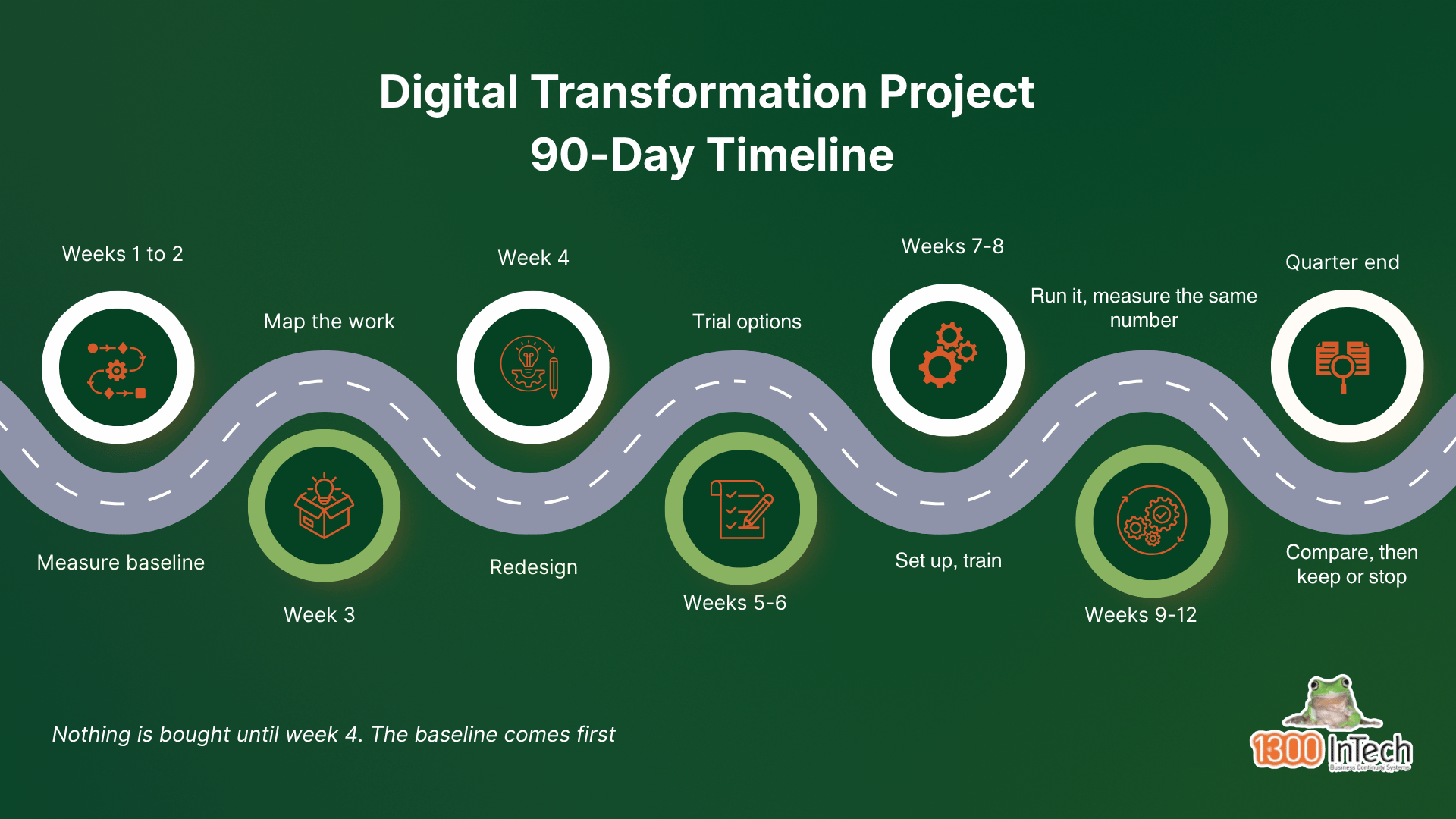
- Weeks 1 to 2: Pick one process and measure it. Record the baseline in writing.
- Week 3: Map how the work flows now, with the people who do it.
- Week 4: Redesign it on paper. Decide what the tool must do.
- Weeks 5 to 6: Shortlist two or three options. Trial with real work, not demo data.
- Weeks 7 to 8: Set up, migrate only the data you need, and train properly.
- Weeks 9 to 12: Run it, measure the same number, fix what breaks.
- End of quarter: Compare against the baseline and decide whether to keep, adjust or stop.
Then choose the next process. Sequential beats simultaneous when nobody is dedicated to the project, and it keeps a transformation journey affordable.
Why digital transformation projects fail
Buying before measuring. A preliminary 2025 report from MIT's Project NANDA, drawing on more than 300 disclosed AI initiatives, 52 interviews and 153 survey responses, found around 95% of enterprise generative AI pilots showed no measurable effect on profit and loss. The authors put the gap down to approach rather than technology. It has not been peer reviewed, so treat the figure with caution and the direction seriously.
Automating a broken process. A faster version of a badly designed workflow is still badly designed, and now harder to change.
Chasing the visible use case. The same research found roughly half of generative AI budgets went to sales and marketing, while the clearest returns appeared in back-office automation. The impressive project and the profitable one are often different projects.
Doing everything at once. Boston Consulting Group's 2020 study found 30% of digital transformations met or exceeded targets, 44% created some value but fell short, and 26% created limited value with no lasting change (BCG). That covers large organisations, so read it as a caution about scope, not a forecast for your business.
Treating it as a project with an end date. Operating models revert once the attention moves elsewhere. The businesses that keep the gains treat improvement as something they do continuously, not once.
No named owner. Projects belonging to everyone finish for nobody.
Privacy and cyber security obligations worth planning around
From December 2026, businesses covered by the Australian Privacy Principles must disclose certain automated decision making in their privacy policy. It applies where a computer program makes, or does something substantially and directly related to making, a decision using someone's personal information that could reasonably be expected to significantly affect their rights or interests (OAIC).
The practical point: automated screening, scoring or triage bought from a vendor still counts. If you are choosing a tool this year that makes or assists decisions about customers, applicants or tenants, ask the vendor now how it works. Whether your business is covered depends on turnover, sector, and use, so confirm your position with a qualified adviser.
When to get outside help, and what to ask
Bring in outside help when the project crosses systems you cannot afford to break, when data migration is involved, or when nobody internal has time to own it. For a single process of improvement, many owners run it themselves.
Questions worth asking any prospective partner:
• What business number will this change, and how will we measure it?
• What will you change about the process, not just the software?
• Who owns the data, and how do we export it if we leave?
• What does this cost in year two, including licenses and support?
• Which parts can our team do to reduce the fee?
• Can you show comparable work at our scale?
Be wary of a proposal that opens with a product name rather than a question about your operations. Sound business strategies start with the outcome. If it would help to talk about the options first, that is what our IT consulting conversations are for.
A good technology partner comes down to one person: "the link", that is the individual assigned to guide you into the new system. Get the right one and your chances of success improve enormously; they know the product inside out, make time for all your questions, and offer workarounds and alternatives that shape the best outcomes. The warning sign I've learned to watch for is the opposite of that: when no single person owns your account, when the salesperson who knew the product disappears the day after you sign, and you're handed to a faceless support queue. If nobody on their side can answer a hard question without "getting back to you", that's the tell.
For Melbourne and Victorian businesses
The Victorian Skills Plan identifies Melbourne's CBD as Australia's largest AI cluster, with 188 AI firms and around 22% of the country's AI startups and scaleups (Victorian Government). For an owner shopping for help, that means a deeper pool of specialists and more competition on price than most Australian regions.
There is also free support. Business Victoria's Business Skills Mentoring Program offers three free one-hour sessions covering areas including digitalisation and change management, for businesses with 20 or fewer employees in seven priority sectors. Expressions of interest close at 5pm on 31 August 2026, or earlier if places fill (Business Victoria). Confirm eligibility before applying.
Where to start
Pick the process that annoys you most and spend two weeks counting it. Hours, days, errors, missed enquiries, whichever fits. Do not buy anything yet.
That baseline costs nothing and turns a vague sense that things could be better into a decision you can make. Customer experiences improve fastest when the underlying process changes, not when another tool joins the pile. If the problem runs wider than one process, that is the point of seeking tailored advice.
Frequently asked questions
Is digital business transformation only for large companies?
No. The term comes from enterprise consulting, but the underlying idea, redesigning how work is done rather than just buying tools, applies at any size. For a small business it usually means improving one or two high impact business processes rather than running a company wide program.
How is digital business transformation different from just buying new software?
Software changes the tool. Transformation changes the process, who owns it, and how the result is measured. If your team follows the same steps in the same order after implementation, you have digitalised a process rather than transformed it. Both are valid, but they cost different amounts and deliver different results.
How much does digital transformation cost a small business?
There is no standard figure, because cost depends on how many systems are involved and how much of the work you do internally. The cost drivers are consistent though: software subscriptions charged per user per month, data migration and cleanup, integration work between systems, staff training time, and ongoing support from year two onward. Ask any provider to quote the second year as well as the first, since that is where the real running cost shows up. Starting with one process keeps the initial commitment small and gives you a real number before you scale.
How long does a first digital transformation project take for a small business?
A single process improvement can realistically run in about 90 days, including two weeks of baseline measurement before any tool is chosen. Timelines depend on data quality, how many systems are involved, and staff availability.
How do I know whether the change actually worked?
Record the relevant number before you start, such as hours per week on the task, days from enquiry to quote, or the proportion of jobs needing rework. Measure the same number after the change. Without a baseline, return on investment cannot be demonstrated.
Which process should I improve first?
Choose the one where delays, duplicated data entry or errors cost the most, and where the cause is clear. Processes that make customers wait usually have the strongest commercial case because they affect both revenue and reputation.
Do I need an external technology partner?
Not always. Single process improvements are often manageable internally. External help is worth considering when the project touches systems that cannot afford downtime, involves migrating data between platforms, or when nobody internally has the capacity to own it.
What are the main risks?
The most common are automating a process that should have been redesigned first, low staff adoption, poor data quality producing unreliable outputs, vendor lock in with no export path, and increased exposure to cyber incidents when new systems are added without security controls.
Does moving to the cloud improve my cyber security?
Not automatically. Cloud platforms are maintained and patched by the provider, which removes some burden, but they also add accounts and access points. Security depends on how the service is configured and who can reach it. Multi-factor authentication, current backups, and reviewed access permissions matter more than where the system is hosted.